Asking isn't just faster than searching. It's better.
Field Notes · Andrew O'Driscoll, Founder, RevOps Sherpas · May 2026 · 7 min read
Retrieval used to eat the consulting hour. When asking replaces searching, the reasoning gets the time it deserves — and the first hour of a Gong engagement changes shape.
Asking is faster than searching. The interesting part is what that does to the work.
Most people working with data today would rather type a sentence than open a dashboard. That shift has happened almost everywhere at once, and it's now the default expectation. What's worth paying attention to isn't the speed gain. It's how the work itself moves when retrieval stops being the bottleneck.
We learned this building for ourselves, on our own engagements. We walk into a customer's Gong instance and we're expected to form a real point of view in the first hour. Not a polite read. An actual diagnosis: what's working, what isn't, where the leverage is, and what we should do first. That's the job.
The data is there. It's just scattered.
A Gong instance is not one data source. It's many, each good at a different kind of question, and any honest read of one usually requires another.
The Gong UI is excellent for the questions Gong has already decided are important. Call activity by rep, coaching scorecards, deal warnings, account briefs. If your question matches a screen Gong built, you're done in a click. If it doesn't, you're stuck.
CSV exports cover the next layer. They give you what the UI shows, plus more, in a format you can pivot. The cost is that you're working with a snapshot and you have to stitch exports together yourself. Two exports from two different screens don't always share keys cleanly.
The Gong API opens up the things the UI doesn't surface at all. Call metadata at scale, user-level activity, integration health, raw participant lists. It's the right tool when you need precision or volume, and the wrong tool when you want to look at something quickly.
Gong Data Cloud is the warehouse-grade option for customers who have it. Full historical data, SQL access, joinable to everything else in your stack. It's the most powerful and the highest friction, and not every customer has it turned on.
That's just the starting set. There are other sources we pull from too — the shape of the problem varies by customer. What stays constant is that the question a customer actually cares about almost never lives in one place. Recording coverage is breaking down in the West region is a UI question that becomes an API question the moment you ask why. License utilization is low is a CSV question until you want to know which licenses, on which teams, doing which kind of calls — at which point you're across most of them.
Most of the consulting hour used to go to retrieval.
If you're a Gong-literate consultant walking into a new instance, the bottleneck isn't analysis. It's reconciliation. You pull the call activity export, you pull the user license list, you query the API for recording status, and then you sit with all of it in a spreadsheet and try to figure out what the views together actually say. The reasoning part — the part the customer is paying for — happens last and gets the least time.
Retrieval and collation ate the day. Gong Lens changed that.
What we built, and why
We built an internal application called Gong Lens. It pulls together the data sets we were constantly cross-referencing into one view — recording health, feature adoption, license utilization, talk patterns, coaching activity, integration status — and lets us ask questions across all of it in plain English.
Lens has two layers, and the distinction matters.
The first layer is the familiar one. Dashboards for each data set, sortable, filterable, drillable. This is where we go when we want to see the shape of something. License utilization across a 200-seat instance has a shape. Coaching activity across managers has a shape. A dashboard shows you the shape; a sentence doesn't.
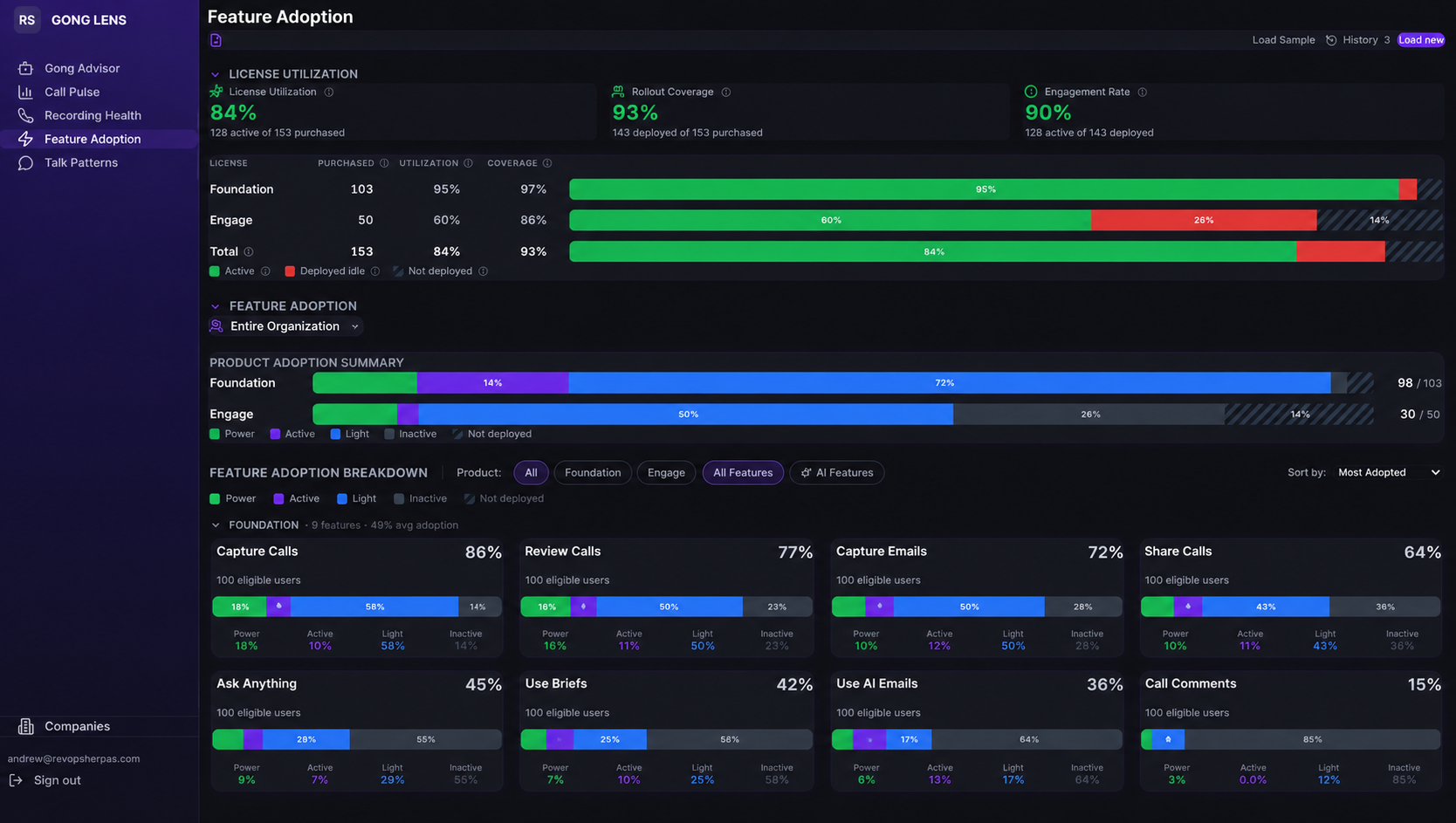 Layer one: a dashboard for license utilization. Useful when you want to see the shape of something.
The second layer is an AI advisor that sits on top of all of the data sets and inside each one. We can ask scoped questions of a single data set or broad questions that cut across all of them. The dashboards are for the things we want to see at a glance. The advisor is for the questions we don't have a pre-built view for. That's most of the interesting questions.
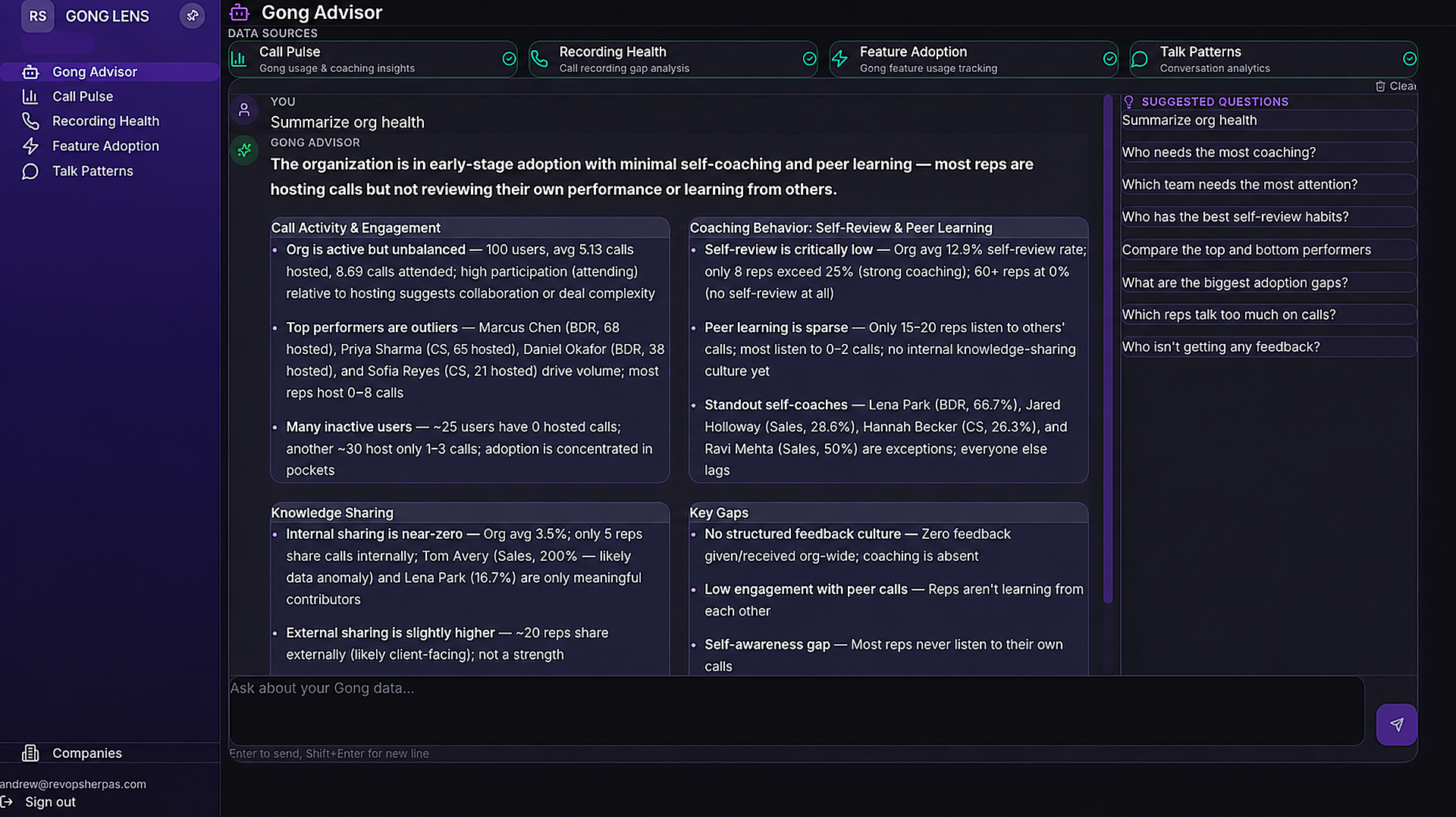 Layer two: the advisor answering a broad question across every data set.
The kind of thing we can now answer in a sentence
A flavor of what the first hour of an engagement looks like now:
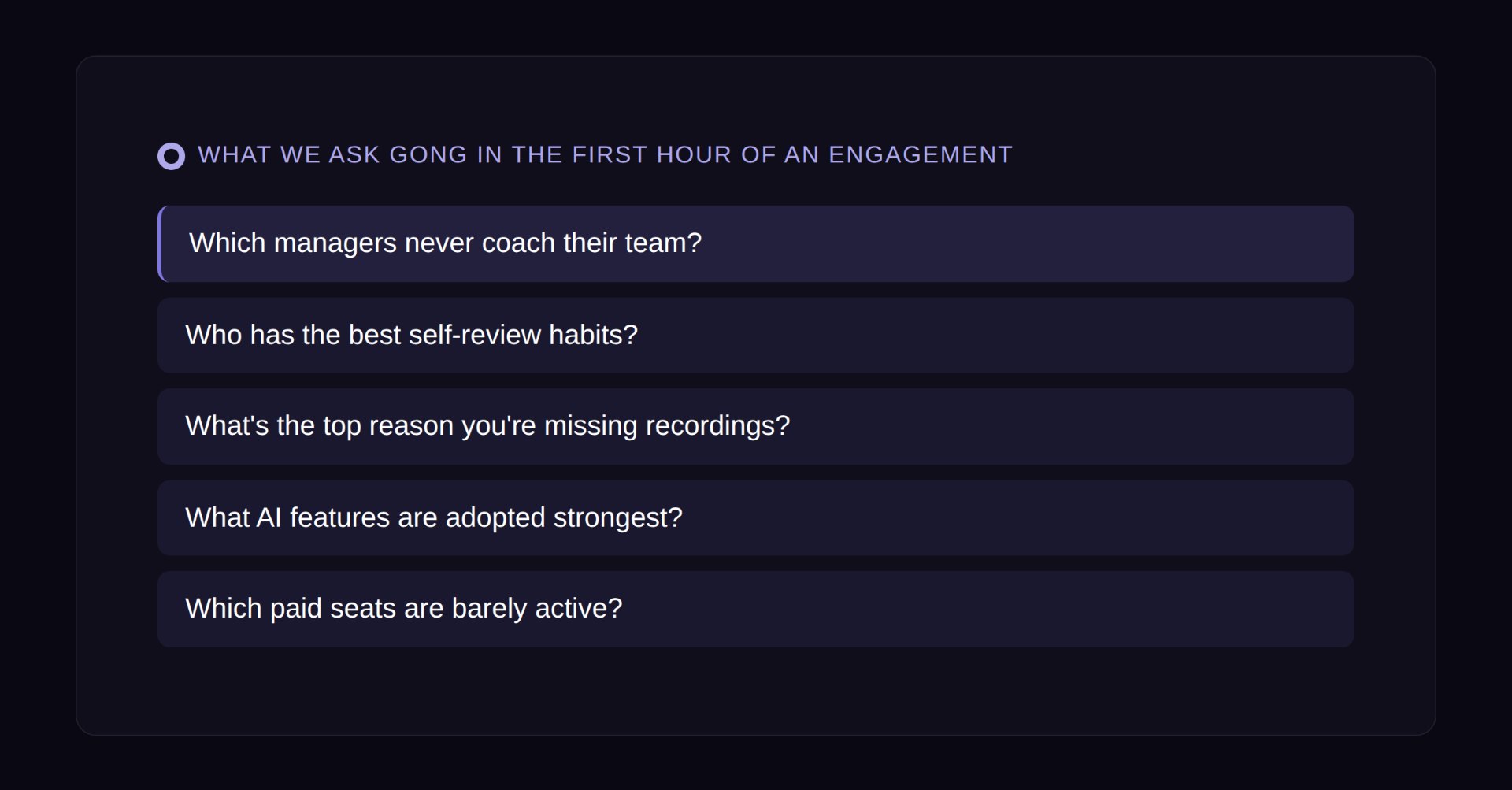 A handful of the questions we reach for at the start of an engagement.
"Which reps are hosting more than 50 calls a month but self-reviewing fewer than 5% of them?"
This used to require pulling a call activity export, pulling a self-review export, joining on user ID, and filtering. Now it takes a sentence. The answer is usually a list of five to ten people, and the list is the conversation we want to have with the customer.
"Where is recording coverage breaking down, and are those misses controllable or not?"
Controllable means a configuration problem we can fix. Not controllable means a user behavior problem or a telephony edge case. Knowing the split before the kickoff changes what we recommend.
"Of the seats this customer is paying for, how many are barely active?"
And then the follow-up: "Which teams are those inactive seats sitting in?" The first is a commercial question dressed as an adoption question. The second tells the RevOps leader whether the next Gong renewal conversation should be about expansion, rightsizing, or a targeted enablement push in one specific team.
"Which managers haven't coached a rep this month?"
Coaching is the part of Gong that most often goes dark first, and it goes dark quietly. A single answer to that question, on day one, reframes the entire engagement. You stop talking about features and start talking about behavior.
None of these are exotic. They're the questions a good consultant has always wanted to answer in the first hour. They used to take real time. Now they take a sentence, and the time goes to what to do about the answer.
Where this is going
Lens is internal for now. We use it on our own engagements. We may commercialize it eventually — there's clearly demand for the shape of the thing, because every Gong customer we talk to has some version of the same fragmented-data problem. Gong might cover this ground too. Their AI investment so far has been on the conversation side: the spoken word, the email, the deal. That's the right place for them to be focused. Whether they extend that capability to the usage and adoption layer is their call, on their timeline. In the meantime, we needed it now, and necessity is a good reason to build.
The bigger point isn't about our tool. It's that the data has been sitting in your Gong instance the whole time. The interesting question was always what to ask of it. For most of the last few years, the answer was "whatever was cheap enough to retrieve." That constraint is gone now, and the work that was already worth doing is suddenly worth doing first.
If you want help getting your Gong instance to that level of usefulness, book a call.
Tags: Gong, AI, RevOps