Connect any CRM to Gong.
Bring your CRM into Gong. Like it was native.
LISTED ON THE GONG COLLECTIVE
THE PROBLEM
Without CRM, you're using a fraction of Gong's Power.
Deal boards, account briefs, deal briefs, forecast signals, and win-loss analysis — every part of Gong that turns conversations into revenue intelligence is anchored to CRM objects. Without a CRM connection, Gong can't even ingest emails, so half the conversation is missing too.
No pipeline. Just a list of calls.
Without CRM, there's no pipeline view in Gong — because there's no pipeline. Just calls floating without accounts, deals, or stages to organize them around. Managers can't see what's progressing, what's stuck, or what's at risk.
No CRM context. No AI briefs.
Account briefs, deal briefs, contact briefs, deal warnings, forecast signals — Gong's AI surfaces all depend on CRM objects to anchor against. No CRM, no briefs. The intelligence layer you bought Gong for goes dark.
No win-loss signals.
Without calls and emails tied to CRM records, there's no closed loop — no way to see which talk tracks win, which behaviors lose, or what separates closed-won from closed-lost.
HOW IT WORKS · LESS THAN A WEEK TO GO LIVE
From access granted to data flowing — in less than a week.
Connect
OAuth-based install for both your CRM and Gong. Industry-standard, secure, and we walk you through every step.
Map
Across Accounts, Contacts, Deals, and Leads, you choose which fields sync — standard or custom.
Test
Run a controlled sync, validate records in Gong and your CRM, and review the results together before going live.
Go Live
Switch to autonomous bi-directional sync every 15 minutes, with full visibility into status and exceptions.
GONG INSIGHT IN THE CRM
Gong insight, back where your team works.
Getting your CRM into Gong powers deal boards, briefs and forecasting. The loop closes when Gong's intelligence shows up on the record your sellers already have open. CRM Connect does that two ways.
WRITTEN TO THE RECORD
Call summaries on the CRM record
Gong call summaries are written back to the CRM as activities for calls linked to a record, on the same sync that brings your CRM data into Gong.
ASKED LIVE, VIA MCP
Ask Gong from inside the CRM
An Account AI widget on Account and Deal records. Reps run the account and deal briefs already set up in Gong, or ask their own question, and get answers in real time from the latest calls, emails and CRM context in Gong.
See an example in Zoho CRM →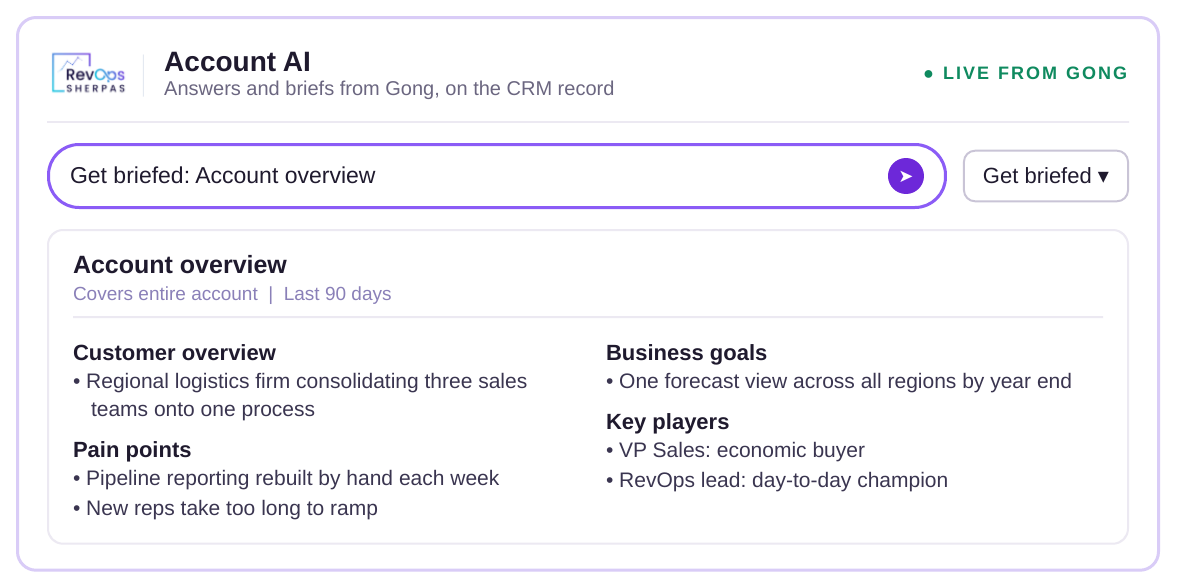
Live questions use Gong AI credits, and usage is visible to your admins.
WHY COMPANIES DON'T BUILD THIS THEMSELVES
Three reasons not to build this yourself.Three reasons you don't have to.
THE PROBLEM
Build it yourself, and you own two APIs.
To do this in-house, your team has to learn and maintain two APIs — your CRM's, and Gong's CRM CRM API — then build the translation layer in between. You're effectively the translator between two systems: pulling from one shape, transforming, validating, and pushing into the other. It's not science, but it's medium-to-high engineering effort, and once you ship it, you own every API change on both sides forever.
OUR ANSWER
Fully Managed Service
We've already done the work. Our translation layer is built, in production, and battle-tested across multiple CRMs. We monitor every sync, handle every error, and absorb every API change on both sides — Gong's and your CRM's — for the life of the contract. Your engineering team never sees a ticket. Your RevOps team gets a managed service, not a project.
THE PROBLEM
Simple choices shouldn't become change requests.
When an integration gets built — whether in-house, by a contractor, or through a point solution — flexibility is usually the first thing that gets scoped out. Not because anyone cut corners, but because building a real configuration layer (field pickers, sync rules, conflict handling, diagnostics) is a product in itself. So the integration ships, it works, and then every later decision — a renamed field, a new object, a different stage rollup — becomes a change request to whoever built it. The data is moving faster than the config can keep up.
OUR ANSWER
Built for the admin, not the engineer.
We built the configuration layer so you don't have to. A visual field picker lets your admin map any CRM field to any Gong object in a few clicks. Sync direction, filters, conflict rules, object scope — toggles, not tickets. And when something looks off, built-in diagnostics show exactly which record, which field, and why, so your team can resolve it themselves. Clicks, not code. Decisions, not dependencies.
THE PROBLEM
Integrations are never done. They're version one.
The day you connect CRM to Gong is day one. Then comes writeback. Then call writeback. Then trackers. Then self-service diagnostics for sync exceptions. Then more fields, more objects, more directions. Every integration you've ever owned has a roadmap — and someone has to own building, prioritizing, and shipping it forever.
OUR ANSWER
You're not buying a sync. You're buying a roadmap.
We're already on version N. Bi-directional sync, conflict resolution, idempotency, error recovery — built and shipped. New capabilities land continuously, and every customer benefits from every release. You inherit a product roadmap that's been compounding for years, instead of staffing one of your own.
PRICING MODEL
Priced per Gong user. No surprises.
- •Annual subscription: $360 per Gong Foundation user, with volume-based pricing — per-user cost decreases at higher user counts.
- •One-time implementation fee: $500–$750.
- •A $5,000 annual minimum spend applies.
Requires an active Gong license.
RELATED OFFERINGS
CRM Connect is one piece of a complete Gong data layer.
QUESTIONS ANSWERED
Common questions about CRM Connect
Bring your CRM into Gong.
Book a discovery call and we'll map out what it takes to get your CRM and Gong working as one.